For decades, the image of a stressed American student was iconic: desks buried under physical textbooks, all-nighters fueled by caffeine, and the frantic search for a library book that someone else had already checked out. Today, that image has shifted. While academic pressure remains at an all-nighters high, the nature of that stress is being fundamentally reshaped—and mitigated—by technology.
From high schools in suburban districts to the lecture halls of Ivy League universities, technology is no longer just a “tool” for learning; it is the primary infrastructure for mental well-being and academic efficiency. In this comprehensive analysis, we explore how digital innovation is lowering cortisol levels and raising Grade Point Averages for students across the United States.
1. The Death of Information Scarcity
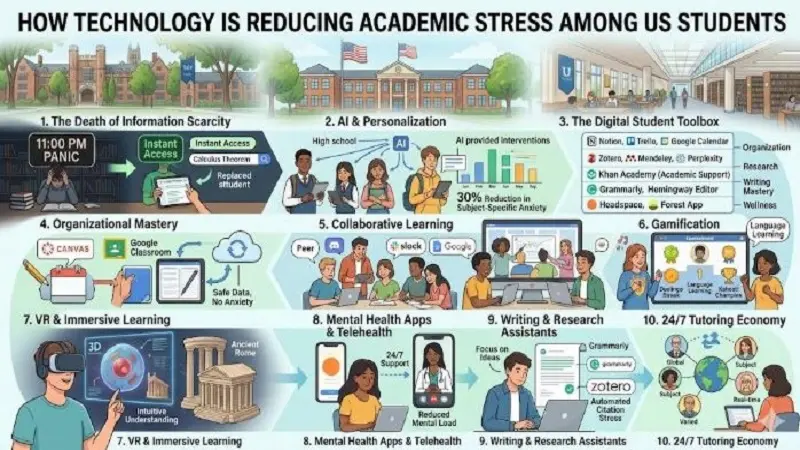
Historically, a major source of academic stress was the “search cost” of information. If a student didn’t understand a calculus theorem or a historical nuance, they were limited to their class notes or the availability of a teacher. This created a “knowledge bottleneck” that often resulted in late-night anxiety and stalled progress.
Today, the democratization of expertise through platforms like MyAssignmentHelp and massive educational databases has provided 24/7 access to clarified concepts. When deadlines loom and students think, “I need someone to write my assignment to get back on track,” these digital archives and expert services offer a vital safety net. This “on-demand” nature of information means that the 11:00 PM panic—when a student realizes they are stuck on a complex problem—is replaced by a quick search for a walkthrough or a professional explanation. When the barrier to understanding is lowered, the psychological weight of “getting stuck” evaporates.
2. AI and Personalization: The End of “One Size Fits All”
The American classroom has long struggled with the “middle of the road” teaching style, which often leaves struggling students behind and advanced students bored. Both scenarios create significant cognitive load and emotional distress.
Artificial Intelligence (AI) has introduced Adaptive Learning Paths. These systems analyze a student’s performance in real-time, identifying exactly where their knowledge gaps lie. Instead of failing a mid-term because they missed a foundational concept three weeks ago, students receive targeted interventions. In instances where the workload becomes overwhelming, many choose to pay someone to do your assignment as a strategic way to manage their mental bandwidth and focus on mastery rather than just completion.
According to recent EdTech trends, students using AI-integrated personalized platforms report a 30% reduction in “subject-specific anxiety.” This “just-in-time” learning ensures that students feel competent, and competence is the greatest enemy of academic stress.
3. The Digital Student Toolbox: Essential Gear for 2026
To achieve “Academic Zen,” US students are increasingly relying on a curated stack of software. These tools don’t just help with grades; they manage the mental energy required to function in a high-pressure environment.
| Category | Primary Tools | Stress-Reduction Benefit |
| Organization | Notion, Trello, Google Calendar | Eliminates the “mental load” of tracking deadlines. |
| Research | Zotero, Mendeley, Perplexity | Automates citations and synthesizes complex data. |
| Academic Support | MyAssignmentHelp | Provides instant clarity on difficult curriculum topics. |
| Writing Mastery | Grammarly, Hemingway Editor | Reduces “blank page syndrome” and editing fatigue. |
| Wellness | Headspace, Forest App | Encourages “Deep Work” and mindfulness breaks. |
4. Organizational Mastery via Executive Function Tools
Executive dysfunction—the inability to manage time, tasks, and deadlines—is a leading cause of burnout among US high schoolers and college students. The “mental load” of remembering when a chemistry lab is due versus when a literature essay needs a rough draft can be overwhelming.
Modern students utilize a suite of organizational tools to offload this stress:
- LMS Platforms (Canvas, Blackboard, Google Classroom): These serve as a “central nervous system” for assignments, ensuring nothing “slips through the cracks.”
- Digital Planners and Second Brains: Apps like Notion allow students to break down massive projects into “micro-tasks,” making the impossible feel manageable.
- Cloud Synchronization: The security of Google Drive and OneDrive ensures that a student’s hard work is always safe, removing a massive layer of technical anxiety regarding data loss.
5. The Rise of Collaborative Learning Environments
Academic stress is often exacerbated by isolation. The feeling that “I am the only one who doesn’t get this” can lead to a downward spiral. Technology has turned learning into a social, collaborative effort.
Through Discord servers, Slack channels, and collaborative tools like Figma or Google Docs, students are constantly connected. They can peer-review each other’s work in real-time and provide emotional support. This sense of community acts as a safety net that catches students before they fall into a stress-induced crisis.
6. Gamification: Turning Toil into Play
The human brain is wired for rewards. Traditional grading systems offer “delayed gratification,” which is a recipe for procrastination. Educational technology has introduced “gamification” to bridge this gap.
Apps like Duolingo for languages or Kahoot! for classroom reviews use streaks, badges, and leaderboards to trigger dopamine releases. When studying feels like a game rather than a chore, the “activation energy” required to start decreases. By lowering this barrier, technology helps students avoid the stress of last-minute cramming.
7. Virtual Reality (VR) and Immersive Learning
For many students, stress comes from the abstract nature of certain subjects. High schools and universities across the US are increasingly adopting VR to solve this. By stepping “inside” a human cell or walking through a virtual reconstruction of Ancient Rome, students gain an intuitive understanding of the material. Immersive learning bypasses the stress of rote memorization, replacing it with experiential knowledge that sticks.
8. Mental Health Apps and the Telehealth Revolution
Perhaps the most direct way technology reduces stress is through the democratization of mental health support. Apps like Headspace or Calm, often provided free by educational institutions, offer guided meditation and stress-reduction techniques specifically tailored for students. Furthermore, online therapy platforms allow students to speak with licensed professionals from the privacy of their dorm rooms, removing the logistical hurdles of seeking help.
9. Writing and Research Assistants: Focused Creativity
The “blank page syndrome” is a significant stressor. Tools like Grammarly and citation generators act as “digital editors.” They allow students to focus on their ideas and arguments rather than the minutiae of comma placement or APA formatting. This shift from “formatting stress” to “intellectual engagement” makes the writing process significantly more rewarding.
10. The 24/7 Tutoring Economy and Expert Support
The traditional tutoring model was expensive and tied to a physical location. Digital platforms have leveled the playing field entirely. Whether a student needs help with a complex coding project or a Shakespearean analysis, they can connect with experts globally via Myassignmenthelp.com. This accessibility ensures that academic help is no longer a luxury for the wealthy, but a utility available to anyone with an internet connection.
Frequently Asked Questions
Q.1 Can technology actually increase academic stress through “digital distraction”?
While social media and constant notifications can be distracting, the key is “digital literacy.” Using tools like “Freedom” or “Cold Turkey” to block distracting sites during study hours allows students to use technology as a shield rather than a source of stress.
Q.2 Is it ethical for students to use AI for academic support?
Ethical AI use involves using technology as a “tutor,” not a “ghostwriter.” Tools that explain concepts, suggest outlines, or provide feedback help students learn the material more deeply. When used to bridge knowledge gaps, AI is a powerful ally for academic integrity.
Q.3 How do digital tools help students with learning disabilities like ADHD or Dyslexia?
Technology provides essential scaffolding. For students with ADHD, digital planners and timers manage executive function. For those with Dyslexia, text-to-speech software and specialized fonts reduce the cognitive load of reading, allowing them to focus on the content of the lesson.
Q.4 Are these academic technology tools affordable for the average US student?
Many of the most effective tools, including Google Workspace and basic versions of Notion or Grammarly, are free for students. Additionally, platforms like Myassignmenthelp.com offer scalable support that is often more cost-effective than traditional, in-person private tutoring.
Q.5 What is the best way to start integrating EdTech into a study routine?
Start small. Choose one organizational tool (like Google Calendar) and one academic support resource. Mastering one tool at a time prevents “tech fatigue” and ensures the digital ecosystem remains a source of relief rather than another task to manage.
Conclusion: A Balanced Future
Technology is not a “magic wand” that eliminates the need for hard work. However, it has successfully removed many of the unnecessary stressors that used to plague the American student experience. As we move further into the late 2020s, the goal is no longer just to survive the semester, but to thrive within it—supported by a digital ecosystem designed to keep stress low and potential high.
About the Author:
- Drake Miller is a blog author and senior academic strategist specializing in the intersection of EdTech and student wellness. With over a decade of experience in the higher education sector, he focuses on how digital infrastructure can be leveraged to improve academic outcomes and reduce student burnout across the US and Australia. See more